top of page




Use the arrows to navigate and the middle button to visit the page!
Cards of Heart
Lead Designer
Team of 4 Designers
IGF Honorable Mention for Best Student Game 2025
Engine: Unity
Tools: Perforce, Google Suite
.png)
.png)
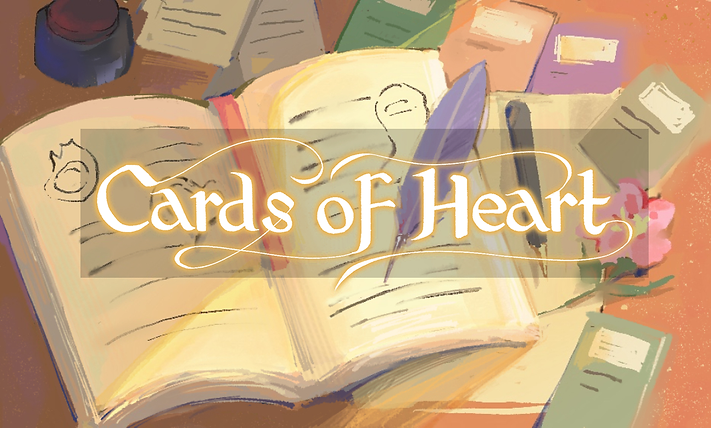
Cards of Heart is a narrative deck-builder teaching players about psychotherapeutic practices through its mechanics and narrative. Players follow Amalia, a young girl struggling with symptoms of depression and anxiety whose grief manifests as monstrous Shadows—guided by a light-spirit Ljos, Amalia learns therapeutic techniques, represented by cards and skills, to fend off the Shadows and come to a sense of healing. To help bring this vision to fruition, I lead our team of 4 designers to produce a set of 41 distinct collectible cards to use in 4 unique boss fights.
Card Design by Archetype
Players balance three stats, which count as health and gates for playing cards. Empowerment represents Amalia's feeling that she can change her circumstances, Hope represents Amalia's belief that things can change in the future, and Connectedness represents Amalia's awareness of her own relationships.
Each card plays off of one of these stats, so when creating our design framework I broke down each into respective archetypes that would inform what types of cards each stat would support, cataloguing the analysis in a reference spreadsheet for the team. There, me and the other designers wrote out a guide for what sorts of effects we expected from each stat, which informed our card designs. The biggest and flashiest cards, payoffs for heavily investing in a stat, were designed to be the most distilled expressions of these categories.

Juggling so many cards meant I worked with our director to create a tracking sheet, which allowed us to balance ratios of card stat, strength, and role.

Empowerment Cards translated to aggressive archetypes, utilizing mechanics such as direct damage, setting up Chains (cards with the same Chain Type can be played together), and damage reflection. Cheaper cards did chip damage to the boss, gave minor empowerment boosts, and partially reflected damage, while the payoffs are the single strongest hit in the game, sapping the Shadow's health to boost Empowerment, and reflecting an attack twofold.


Hope cards mapped to a control archetype, utilizing mechanics such as buffing any stat, damage prevention, and long-lasting effects. Cheap hope cards allowed players to buff any stat, cleanse debuffs, and block, while expensive payoffs set up damage over time and absorbed incoming damage.


Connectedness cards played more towards combo and general supportive cards. Cheap connectedness cards cleared debuffs, set up minor buffs for the player, or inflicted minor debuffs to the shadow. Connectedness payoffs included doubling damage, gaining lifesteal, and the Friend Deck. Unique to Connectedness, reaching a high enough value gave players a permanent extra draw from a deck of powerful cards given to them by a companion met along their journey—companion cards were designed to be strong and tailored to the character you bonded with, serving as an alternate win-condition or new build around, giving the stat some unique depth.


In general, each stat was given unique mechanics to encourage players to utilize all three, at least to some extent, in a battle, but also be able to specialize in one should they choose. We also avoided effects that might enable ludonarratively dissonant play. For instance, card draw is a fairly universal card game mechanic. But due to cards Chaining, drawing cards is very powerful, to the extent that drawing through and playing tons of cards in one massive turn doesn't align with the cozy atmosphere or more gentle approach towards mental health.
Top Down Boss Design
Integral to Cards of Heart is the integration of scientifically grounded mental health research, which allowed me to combine my love of card games with my pre-med education and direct our team towards design directions for the game's Shadows.
Each Shadow represents a negative thought pattern Amalia grapples with which directed their design: internalizing that she's a "failure," all or nothing thinking, magnifying failures and minimizing accomplishments, and the suppression of grief.
Grove Shadow
.png)
This shadow is both Amalia and the player's introduction to the system, which meant our first goal was creating a simple set of mechanics for the boss, then determining what information we wanted to teach player and in what order.
This Shadow's thought, "you're a failure," is meant to be repetitive and relatively easy to disprove, which lent it towards well towards simple damaging attacks and debuffs in a periodic pattern.
I ran collaborative whiteboarding sessions early on so we could flesh out the order of events and spot any spots information could go missing. First, the Shadow deals damage, posing the question of how player how they will survive the threat. The player then learns to mitigate that threat by buffing the desired stat. Then the player learns to convert that advantage into a win by damaging the Shadow.

Garden Shadow

Representing all or nothing thinking, the Garden Shadow was designed to interact with peaks and valleys.
My early brainstorms focused on the Shadow having a big effect that the player could mitigate—for a cost. However, we decided that the because Amalia was being afflicted by the Shadow, the shadow should harness the power of these negative thoughts instead. So we pivoted towards giving the Shadow a damage threshold that the player has to break through in a single turn—the shadow otherwise negates their damage. This change also further reinforced the importance of Chaining and pre-planning turns, as now players sculpt strong hands to unleash a big attack, or reflect some damage on the shadow's turn to chip away at the shield going into their turn.

Marketplace Shadow


The Marketplace Shadow represents minimalization and maximalization—which ties in with nagging feelings of inadequacy.
That nagging feeling became the focal point through iteration. Similar to the Garden Shadow, the initial ideation focused on how the player could best maximalization and minimization, not how something embodying that playstyle would act. We decided that this Shadow would have a large snowball effect, similar to how that feeling of anxiety can build up—over time, the Shadow would get to take more and more actions per turn. Damage would stack up, and it would stack up debuffs to increase its damage potential. This also presented a new challenge for the player, as block cards became less effective and direct damage more so. In turn, we lowered the damage of the shadow and reduced its health, so that racing to defeat it before it defeats you is viable.
Shadow Eleanor


.png)
Shadow Eleanor is the final boss in the game and represents the point in the narrative where Amalia reaches the limits of her logic-based CBT practices.
Because her design could be so broad and was less rooted in a defined principle as the previous Shadows, I ran a brainstorm session to come up with unique and powerful mechanics she could use, then polled the team to see which directions we favored. Collaboration with our engineering team proved key, as some effects such as ending the player's turn proved too time-consuming to add.
A simple solution was to toggle what options the player had access to; she would occasionally temporarily turn of Chaining for the player, incentivizing players to build around higher impact cards as opposed to the relatively dominant strategy of filling the deck with Chain cards. She was also the boss with the biggest hits, getting strong buffs to her damage as the fight goes on. These attacks prove threatening but also allowed for big opportunities if players completed quests to unlock strong cards—for instance, one of the late-game rewards reflects an enemy's attack 2X! Lastly, Eleanor can debuff the player, preventing her attacks from being countered. These three effects in combination, cover for each other's weaknesses, but not all at once, so the challenge comes with building a deck flexible enough to handle whichever comes up at a given time. This in turn mechanically reinforces the Limits of Amalia's approach; there is no one solution to the battle.
bottom of page